|
|
| |
|
Current Issue - Volume 16 Issue 12 (March 2024)
|
|
|
Cover story
|
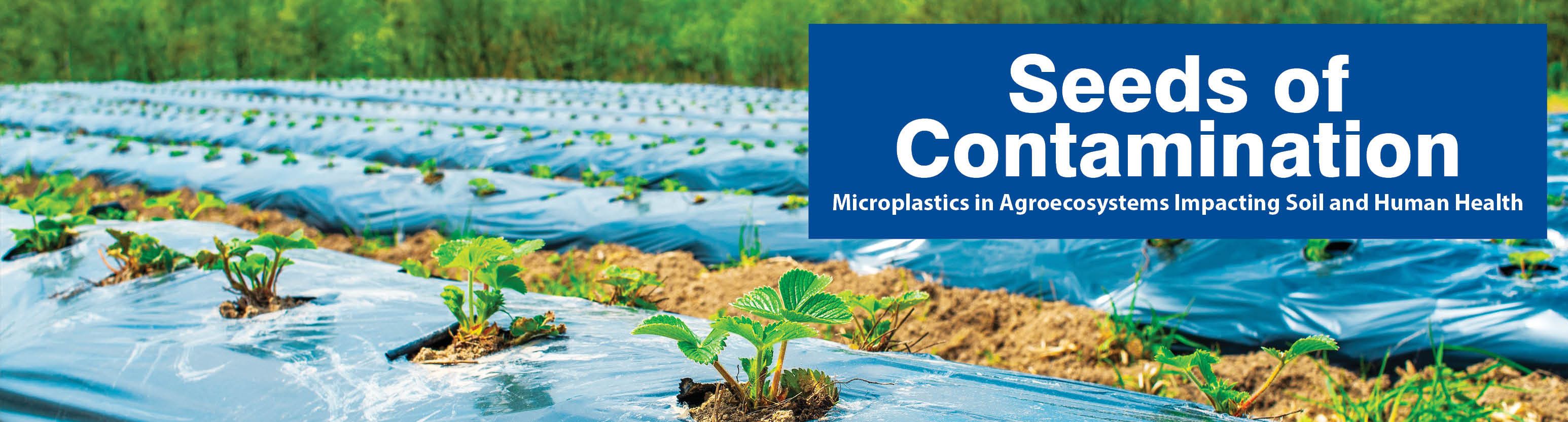
| Seeds of Contamination: Microplastics in Agroecosystems Impacting Soil and Human Health |
 Microplastic pollution in terrestrial environments poses a significant threat to ecosystems and human health. These tiny plastic particles can be found ubiquitously in soils, sediments, and even in the air. Once in the soil, microplastics can disrupt soil structure, affecting water retention and nutrient cycling, thus impairing the growth and health of plants. There are concerns about the potential transfer of microplastics to crops consumed by humans, raising questions about their impact on human health. Anagha Krishnan asserts that microplastic pollution is a significant driver accelerating climate change. This article offers insights into the persistence and toxicity of microplastics in the terrestrial environment. Microplastic pollution in terrestrial environments poses a significant threat to ecosystems and human health. These tiny plastic particles can be found ubiquitously in soils, sediments, and even in the air. Once in the soil, microplastics can disrupt soil structure, affecting water retention and nutrient cycling, thus impairing the growth and health of plants. There are concerns about the potential transfer of microplastics to crops consumed by humans, raising questions about their impact on human health. Anagha Krishnan asserts that microplastic pollution is a significant driver accelerating climate change. This article offers insights into the persistence and toxicity of microplastics in the terrestrial environment.
 read
more
read
more |
|
Feature |
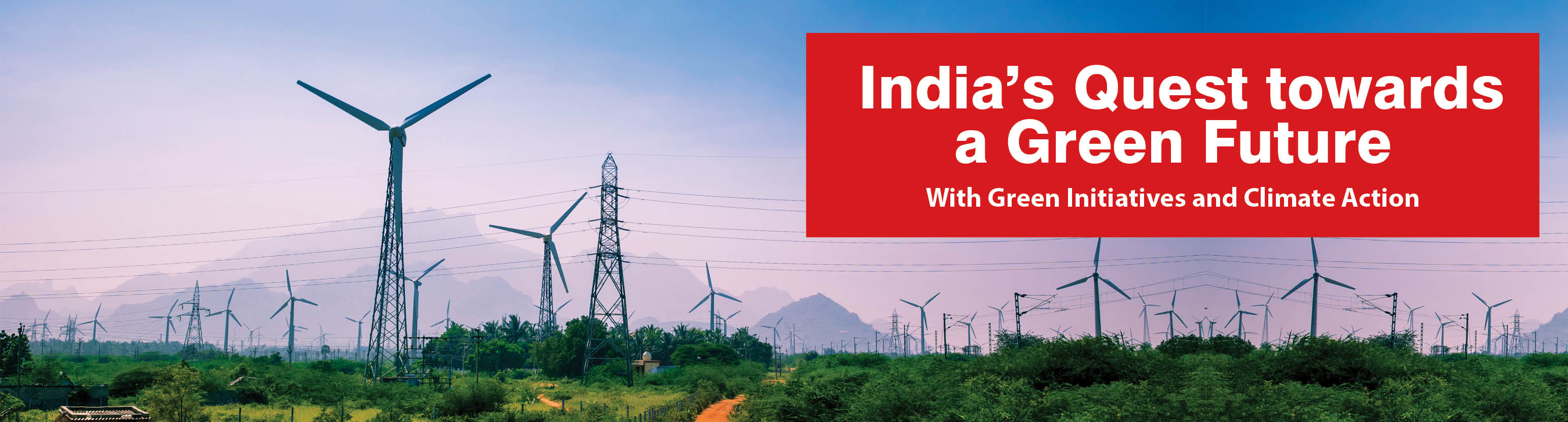
| BIndia's Quest towards a Green Future: With Green Initiatives and Climate Action |
|
 The interim budget of India for 2024–25 has placed significant emphasis on the green economy and investments aimed at combating climate change. These announcements are poised to reinforce India's prior endeavours in this direction. In this article, Sameeksha delves into concepts such as the green economy and climate action, highlighting that through its various initiatives, India has made significant progress towards the target of net zero emissions without compromising its economic development in less than a decade. These steps are expected to have a long-lasting impact, and the rapid growth of the country, coupled with green initiatives, will pave the way for a new era of prosperity. The interim budget of India for 2024–25 has placed significant emphasis on the green economy and investments aimed at combating climate change. These announcements are poised to reinforce India's prior endeavours in this direction. In this article, Sameeksha delves into concepts such as the green economy and climate action, highlighting that through its various initiatives, India has made significant progress towards the target of net zero emissions without compromising its economic development in less than a decade. These steps are expected to have a long-lasting impact, and the rapid growth of the country, coupled with green initiatives, will pave the way for a new era of prosperity.
 read more read more
|
|
|
|
|
|
TERI Analysis |
| Assessment of Bio-CNG: As a Vehicular Fuel in India |
India is at the cusp of mobility revolution. At a time when India's automotive industry is undergoing substantial transformation, a diverse mobility solution is required, which still lags in terms of access to transportation facilities, and introduction of e-mobility is a challenge in immediate future. Bio-CNG has emerged as a potential solution to this sustainable mobility challenge in rural areas. The transition can be accomplished by leveraging nation's significant availability of animal wastes for using Bio-CNG as a cost-effective sustainable alternative for the transport sector. Read about the report 'Comprehensive Environmental and Social Sustainability Assessment of Bio-CNG as Vehicular Fuel in India' published by TERI's Resource Efficiency & Governance Division, which quantitatively attempts to assess the environmental and social sustainability benefits of using Bio-CNG as a vehicular fuel in India. read
 more more |
|
|
|
Green Challenges |
|
| Redefining Development in Tune with Nature: Equitable Human Progress in Harmony with Ecology |
A worldwide congress of individuals synonymous with practising ancient traditional values in the eastern part of Assam, in northeast India, has emerged as a major platform for converging diverse cultures, emphasizing the preservation of ancient traditions, ecological sustainability, and collaborative governance. Through this article, Nava Thakuria informs us that the 8th Triennial International Conference and Gathering of World Elders of Ancient Traditions also adopted the 'Dibrugarh Declaration,' which unequivocally states that ancient wisdom profoundly views human beings as an integral part of the natural ecosystem, rather than as masters.
read
more |
|
Special Report |
|
| Adding the Annoyance Factor into Noise Analysis: Planning for a More Sound Future |
|
In this article, Jochen Schaal and Michel Rosmolen explain how perceptions can be factored into noise modelling.
read
more |
|
Pioneer |
|
|
| Celebrating 'Solar Sisterhood' Power: On International Women's Day |
|
On International Women's Day (March 8), Ashden highlighted the women who made renewable energy happen—especially among the world's poorer communities where energy access posed significant challenges. The theme for this year's International Women's Day was 'Inspire Inclusion'.
read
more |
|
|
In Conversation |
|
| Indian Forest and Wood Certification Scheme: Timely and Effective |
Dr Krishna Kumari, Forestry Faculty, Pandit Deendayal Upadhyay College of Horticulture and Forestry, Dr Rajender Prasad Central Agricultural University, Bihar along with Supriya Rai, a third-year student pursuing BSc in Forestry at the same university, engage in a discussion regarding the objectives and benefits of the IFWCS.
read
more |
|
Special Feature |
|
| Micro-and Nanoplastics Invade Everywhere: Will it Take a Toll on Aquatic Organisms? |
|
In this article, Pritam Sarkar, Sudarshan S, SP Shukla, and Rathi Bhuvaneswari G highlight that microplastics/nanoplastics generate synergistic effects with other environmental pollutants, serving as vectors for contaminants to aquatic organisms. They advocate for future research to prioritize investigating the combined impacts of microplastics/nanoplastics with other contaminants. Furthermore, they emphasize the urgent need to establish a robust framework for reducing the utilization and discharge of plastics into aquatic ecosystems.
read
more |
|
Wildlife |
|
|
| Enhancing Green Cover in HP: Barren Forest Land Converted to Verdant Landscape |
|
Not too long ago, a vast stretch of approximately ten acres of forest land in Parohi and Sangirthi of Bandladhar in the Bilaspur zone of Himachal Pradesh remained barren. The terrain was rocky, with minimal soil depth, making the idea of growing trees there seem implausible. However, today, this unproductive land is transforming into a verdant landscape, with 11,000 saplings of various tree species taking root. Sarita Brara informs that this transformation is attributed to the state government's Mukhya Mantri Van Vistaar Yojana (MMVVY), which aims to enhance green cover across thousands of hectares of barren forest land throughout the state. The MMVVY was officially introduced in 2023.
read
more |
|
|
|

 TERI
Bookstore
TERI
Bookstore